Showing posts with label Music. Show all posts

Monday, 7 September 2026

1,000th Blog Post! The Salmon of Salmagundi!

When I first started writing here (and porting my posts over from Google+ when it closed its doors in 2018), I didn’t set out with a grand plan to get to any particular number - I just ploughed on through when the urge took me and I felt as though I had something to say! There was no calendar, no strategy and certainly no counter running!

I just wanted a space to put thoughts down, tinker with things that interested me and share whatever happened to be occupying my time. Today, this post happens to be number 1,000. If you didn't know, a salmagundi, by definition, is a miscellany - a dish composed of many disparate ingredients mixed together. Looking back across the archive, the blog has certainly lived up to its name. Its name and mine! The Salmon of Salmagundi! I don't have an exact record of when I posted my first post in Google+ but it's now well over 10 years - and possibly 15 - ported across here in the summer of 2018.

If you were to lay out every entry side-by-side, it would look less like a single publication and more like the top of a well-used workbench! A large chunk of those thousand posts has been dedicated to hardware - mobile phones, foldables, e-ink tablets, custom ROMs, obscure gadgets and the endless pursuit of the setup that actually works! We’ve seen the smartphone market evolve from quirky, experimental form factors into polished slabs of glass, only to bend and fold themselves into new shapes all over again. I’ve always found as much enjoyment in taking software apart or tweaking a niche budget device as I have in unboxing a flagship. For every review of a polished mainstream phone, there’s been an entry dedicated to coaxing a few more years of life out of a classic piece of kit, swapping operating systems or testing whether a paper-like screen really lives up to the hype.

Then there is the music. If tech represents the modern, restless itch to see what’s coming next, the music posts have always been about slowing down. Dropping the stylus onto a vinyl record forces a different kind of attention. Over the years, I’ve used these pages to talk through album pressings, soundscapes, audio gear and the sheer tactile satisfaction of physical media. Whether dissecting the production details on a classic album or detailing a pre-amp tweak, those posts have always felt like taking a break from the noise of the digital world to just sit back and listen. My real enjoyment has come from the resurgence of vinyl LPs though and I've had great fun over the years re-collecting what was lost from back in the day - and sharing that nostalgia here.

And, of course, the films and television. My reviews here have never been about chasing whatever blockbuster is currently dominating the multiplex. Instead, Salmagundi has been a place for digging into the side alleys of cinema - indie thrillers, oddball horror, European cinema, lost sci-fi gems and the occasional film that left me wondering what on earth the director was thinking! Writing about film is always a nice counterweight to tech hardware. A phone is measured in gigabytes, battery cycles and refresh rates; a film is measured by whether it kept you gripped for ninety minutes or made you want to drop a brief, honest summary onto the blog the moment the credits rolled. I also, now and again, add a guest review from one of our community pals, who have penned a review of their own and want somewhere online to post it.

Between the major categories lie the posts that don't fit anywhere else - the odd tools, the desk arrangements, the podcast companion notes for Whatever Works and the small observations on day-to-day projects. Those are often the most fun to write. They capture the immediate moment: fixing a piece of audio kit, setting up a new workflow or simply sharing a thought that didn't belong in a formal show recording. And speaking of podcasts, I always publish a list each month here in my blog of what the team and I have been recording and getting out there into podcast land. More spicy ingredients for that Salmagundi!

Reaching 1,000 posts isn't a finish line; it’s just a nice milestone on the road. The core appeal of running a blog like this hasn't changed since post No. 1. It remains a personal, independent corner of the web - free from algorithms dictating what ought to be written and driven entirely by genuine curiosity. To anyone who has dropped by to read a single review, leave a comment, agree or disagree with a film take, or follow along through the podcasts: thank you for your interest and support. Here’s to the next batch of tech, vinyl, films and whatever else happens to land on the desk next week!

Most of what I write here ends up in our MeWe Social Groups as well, so do check those out via the links here on my blog - and feel free to tune into any of our audio podcasts that takes your fancy. We always have a lot of fun, whatever the topic, and you'll be welcome along.

Sunday, 18 January 2026

Phone Memory Cards and Audio Jacks in 2026

There was a tech journo writing today about not missing 3.5mm audio-out sockets on phones on ‘makeuseof’, and then leaning into microSD cards and notification sliders. I never did much care about the latter, but the first two - well, we’ve banged on for years on PSC about how great it is to have them both. However, I have to admit that whenever I get my SIM card into a Sony Xperia phone here, I smile at the 3.5mm audio-out socket and dutifully put my 1TB microSD card into the slot. And then - I realise when I switch to another phone - I have not used either of them once!

I guess for some it’s a ‘nice to have rather than not’, but in today’s super-connected world and with staggeringly good Bluetooth, I wonder just how many people actually still need these things, as the journo has concluded. As for 3.5mm head/earphones, I’m really not audiophile enough to gain any advantage from a physical jack option - and I’d wager that 90% of Xperia (and other phones which claim to have great audio from the jack) users plug in gear that can’t make use of it anyway. Don’t get me wrong - it’s great tinkering fun to see it all work - but in the real world, it’s more likely to annoy by catching cables on door handles or tripping over them, crashing the phone to the floor when going to put the kettle on, than it is of any real use!

Of course, there will be niche cases and people who can and do appreciate the difference - and do have top-notch quality gear that works beautifully in tandem - but it feels like they will be a huge minority. Plugging it into a speaker maybe - well, OK, same applies really - great tinkering fun and nostalgia, but real-world? Of course, everyone is using Bluetooth - and BT on an Xperia phone (and most others now) is staggeringly reliable and good with a long range (usually) that will get you way past the kitchen kettle and most likely to the end of your long, long garden!

Moving away from Xperia, the chap argues that given the quality of one’s phone’s inbuilt DAC, the volume coming out of the 3.5mm jack might not be that high either. "If you like to use high-impedance headphones or quality IEMs, you'll find that the stock headphone audio-out doesn't have the power needed to reach their full potential. Additionally, since Android downsamples hi-res audio files played out of an inbuilt headphone jack, you're missing out on the best quality if you use it. Android often defaults to 48kHz resampling for hi-res audio files played through a default device output, which is higher than CD quality. However, if you want to play files up to 192kHz/24-bit at their full quality, you'll need an external USB DAC. So, despite having a 3.5mm audio-out right there on my phone, I found myself choosing to plug in a USB-C DAC instead" he said. I’m not smart (or audiophile) enough to know if all that is true, but he seems to know what he’s on about!

So then we come to the microSD card function. I live in a world where Plex is my friend. When I’m at home or out and about, as long as my router is on at base, I can just stream whatever I want, wherever I am. Anything from my 16TB HDD. So when do I ever need a microSD memory card? Well, for me and my life, never! But, again, there are people who live in dodgy connection zones or travel through them, and I guess that could impact their life if they can't get to essential files they need for their presentation the next morning. The other point, though, is that baseline storage on phones is going up and appears to be peaking generally, at least out of China, at 512GB now. And that’s surely plenty of movie/TV/music space for anyone planning a night away - or just having it there in case.

But then I suppose if you don’t have it (and/or you haven’t planned ahead for some kooky reason) you could always do something to pass the time. Like going for a pint. Or chatting with another human being. Anyway, the point is that I tend to agree on this based on my behaviour. Not once (beyond testing for reviews) probably in the last 5 years have I actually used data on a microSD card, nor plugged anything into a 3.5mm audio jack! Maybe you’re different.

Sunday, 27 October 2024

Oraolo Wearable Bluetooth Speaker

I do like Bluetooth speakers. You may have noticed! I always seem to have trouble with in-ear buds staying in my right ear. Left is fine. Right is not. I'm clearly deformed! I've tried all sorts of tricks and followed all sorts of tips (literally)! But nothing works. So most of the time it's over the ears/head headphones for me.


I know I shouldn't care about wearing headphones out and about doing my steps in the public arena, but I do. I feel a bit of a numpty. However people reassure me and however many youngsters I see doing it without a care in the world it seems, I just don't feel 'right' about it somehow. So I'm always looking for new ways to listen to music and this time have ended up with something completely new to me, a clip-on speaker known as the Oraolo Wearable BT Speaker!

Amazon has quite a lot of these, mostly, nay all of them, I think, out of China with wildly varying prices - and reviews from people buying them. There are the expensive Sony neckband units which I'm sure are really good (and a load of cheap copies of that) but it seems that there's a lot of cheap rubbish that needs wading through, which I did before settling on this one. Buy one for a tenner and you get what you pay for, to a large degree, it seems. This one's list price is £108.99 today, which is equally absurd! Fortunately, like a good MFI dining room table, it's always on sale - usually with at least 50% off - so bide your time if you're going to, as I got the 50% and a 27% Voucher and ended up paying about £22 for mine! And I think that at that price, it's about right.

It's a neat-looking black unit with a power button up the top of the front, for turning on/off and pairing and underneath, a grille/mesh covering the rest, with big JBL-style plus and minus clicky buttons for volume, primarily. The click is nice and firm. It's the best part of 3" long, just over an inch fat and an inch and a half wide. Then, on the back, there's the 'clip'. It's a strong, sturdy clip which doesn't feel like it's going to break anytime soon. It's almost as wide as the unit itself so affords a good grip to whatever you clip it to. As you can see from the diagram, it's 2.2oz, which is just over 60g, so hanging from a shirt or lapel is really no problem and I have found it to be hardly noticeable. The clip opens up quite broadly so it can be clipped to backpacks, bags or whatever but it's certainly not broad enough to be clipped onto the average bike frame/handlebar - still I guess it can then be clipped to something else on a bike, like a saddle - or probably more sensibly, clothing anyway!

Apart from adjusting the volume up and down, the track can be moved along by long-pressing either of the two plus/minus buttons, but bizarrely, it's minus for forward and plus for back! What? Who thought that would be a good idea, I wonder! The power button is also used for play/pause and answer/end calls. I've tried to invoke Gemini (Live) by using the device itself but can't find a way, however, if you start the conversation on the phone whilst the device is paired and active, you can then walk away from the phone and keep the conversation going both ways with just the speaker. Notifications don't seem to make it through in my testing, like they do with all the same gear but with headphones/buds, this is usually largely down to supporting software/apps, which this doesn't have. So it's really more of a listening/phone calls device. It pairs up quickly and easily and the range away from source actually seems quite impressive with Bluetooth.

The sound is actually quite good. It's not going to win any awards for quality, but it is better and louder than any mobile phone I have ever tried. Not surprising as it would need to be a giant phone to house a speaker the size that's in this thing, dinky as it is! I played around with various phones and their respective Equalisers, even tried out the Wavelet app which we often speak warmly about, and yes, as usual, you can make the sound better than it is without these tools. And there's plenty of volume to play with, so the usual payoff with phones becomes insignificant in that respect.

Out and about is tricky, of course. I have tried it but you have to be very aware of folk around you and not annoying them, as with any sound that's not in one's ears. The bloke on the bus comes to mind! But walking along, alone, it's fine. In amongst loud traffic it's not really. This is for more rural, quieter environments. I have it clipped to my shirt above my sternum and that seems to work well. I did try it clipped to my rucksack's strap on my shoulder whilst in loud traffic, which made it better of course as it's nearer to at least one ear!

It's not just for out and about though. There are domestic uses too, like for example, I had it hooked up to my Roku Streambar, attached to my telly, across the room. That gets the sound of the TV next to the viewer. No stereo of course, but the channels do get routed into mono of course, so you don't lose any of it. And wandering around the house, too, make a cup of tea, go to the loo! And the added benefit over ear/headphones that you can clearly hear what's going on around you if, for example, the doorbell is rung.

The battery supposedly lasts for 18 hours and charges with the supplied USB-A to USB-C cable (or any other one you have). Well, in my tests it actually lasted about 8-10 hours on 100% volume. To get 18 hours, you'd have to have it at 60%, they say in the blurb. It charges up from flat in about 90 minutes. It's supposed to waterproof (to some degree) but I have not tested that!

Anyway, that's been my quick thoughts on the unit and I'm very pleased to have it as an option for when I give up, yet again, with earphones and don't want to use headphones or blast the neighbours with my Marshall Acton III! I do have the JBL Clip 5 but small as that is, it's still not as dinky and light as this one - although you do get significantly better sound. If you get it for the same £22 that I did, then it's certainly worth the outlay. Any more and I wouldn't have bothered.

Saturday, 18 May 2024

Pixel USB-C Earbuds

Remember these? The ones Google used to bundle with the Pixel 3? I think it ended there. I was amazed to learn that the UK Google Store still stocked them, forget Amazon et al..! 20% Voucher and £24.

They sound great. Plugged into all sorts of USB-C devices here - phones, Chromebooks - anything really - and I'm having a whale of a time. No batteries to charge, plug 'em in and listen!

In-line control gets the Google Assistant, Notifications, track forward/back, volume up/down, mic for calls answer/end... and they sound great! (Especially with my PixelBook!)

Marshall Major IV and now V - A feature I forgot about...

Yes, I had completely forgotten (until I watched this video review last night) about the feature that allows for the Major headsets to connect by Bluetooth to a source device and then run a cable to another headset by 3.5mm to share the music with a chum!

Bluetooth is getting very clever with this stuff and can often do the same thing wirelessly now, depending on the gear involved, but here's the old-school way! I'm not aware of any other OEM doing this with headphones.

Thursday, 3 August 2023

Space Q45 SoundCore by Anker Headphones

I have fancied a pair of these since they were released about a year or so ago but always shied away as I already have a Sony XM4 unit and didn't really see the need for both. I'm very pleased, therefore, to now get a loan pair so that I can share my thoughts.

Just to be clear, I'm no audiophile or sound engineer so my observations here are based on my (pretty much) layman's experience - though I have been using headphones of all sorts, shapes and forms for most of my (teen/adult) life - so over 50 years!

The value proposition can't be ignored here and as usual China's Anker's daughter firm SoundCore have knocked it out of the park with regards to features and value. The Sony XM4 unit on release were nearly £400 and these, £150. As we will discover, the Q45s are not as 'smart' as the XM4s but they still have loads of features which generally defy the price-point.

In the box we have a 3.5mm to 3.5mm cable for listening the old-fashioned way, a USB-C to USB-A cable for charging, instructions booklet (for which one might need a magnifying glass) and the headphones themselves. I think there is a carry-case in the original retail unit, but it's not available here. The earcups fold on aluminium hinges 'both ways' so 'back/flat' for turning and placing on shoulder-blades for a break and 'up/in' on themselves for 'as small as possible' storage/transport - much like the Sony ones. There's a subtly-coloured SoundCore logo on the outside of each cup.

The headband is mostly hard plastic with a 'soft' area to line up with the top of the head, between the two side-sliding sizing controls. They seem comfortable in use, even for long-term, much like the XM4s. The actual cushions are very similar in terms of comfort, though the Sony's ear 'shape' is more elongated. The Q45's cushions/cups are more 'round' but certainly not circular - those with very big ears might be better with Sony but I have reasonably big ears and they seem comfortable in both. The two headsets feel about the same weight in the hand (and on the head) and are equally well built/made.

They have a distinctive look, which are not as 'sleek' looking as the XM4s but it's a style symbolic of the brand now with futuristic, yes, spacey, look/feel. There's a secondary circular 'island' on the outside of each earcup with access to buttons and ports. I rather like the styling. On the left 'ring' there's the power/bluetooth/multipoint button, USB-C port and ANC selector. On the right, there's a volume/next/previous track rocker, 3.5mm audio-out port and play/pause button. They all feel firm, solid and like they will last the lifetime of the headphones/battery. These are in black, but you can get them in blue and white too.

The basic controls are fairly obvious, pairing up in the usual kind of way, so next job is to install the SoundCore App on your phone (Android, iOS) and tinker with all the fine controls. The ANC can be engaged and customised on a slider-of-effect from 1-5, ambient sound can also be switched to 'transparency mode' (so off, I guess!) or there's a middle ground dubbed 'normal'. On day of testing it's quite windy outside. Transparency mode lets me hear everything around me quite clearly (depending on the volume level of course), set to 'Normal' most of that 'specific' noise around me (like trains and seagulls making a right old racket!) are hugely reduced but I can still hear the low hum of the wind and set to Noise Cancellation (on slider 5) all that wind goes away and it's pretty silent.

Silent shouldn't be a variable term really, but the XM4s do make it even 'more silent'. That's a market-leading high bar, however, and that very small difference is why they are so well thought of, reviewed and cost so much more. But don't get me wrong, the Q45s are still very, very impressive in terms of NC. Just, as one might expect, not quite the same class as the (arguably) world-leaders. Is that slight difference worth £200 more (RRP)? That's for the user to decide. I'd say categorically no! You can also switch between the ANC/Normal/Transparency modes by using the button on the left cup which rotates between them with each press. There's a (whacking great big) Widget (for Android) if people want to take up half a home screen with it!

More controls in the app relate to equalisation, all sorts of pre-sets which (for a change with this kind of software) actually are very effective and make for a great range of options and changes to listening. There's a HearID Sound function which, like Samsung's tool, leads you through a quite detailed 'hearing test' then offers you a listening experience based on that, should you wish to use it instead of any other equalisation options. Bluetooth v5.3 is included here (multipoint works between two devices, switched by a double-press on the power button or automatically when detected) and LDAC, SBC and AAC for use with supporting devices.

Based on the above, the sound output is of good quality indeed. Setting the most bass available via the controls is not as bass-heavy as the XM4s but for me, I don't have the Sony unit set to anything like the most bass, anyway! Those days are gone and the Q45 sound suits me more as an overall profile and set of options. Others, who blast their ears with brain-crunching bass (watch out for that later in life), might well prefer the Sony sound. The stereo reproduction is nothing short of excellent (testing here with YouTube Music and Motorola Razr 40 Ultra), soundstage wide, separation delightful and no distortion even at top volume and BassUp selected in the app. As always with these tests involving multiple devices you never know quite which is to get the most credit, but the resulting sound in my ears is quite excellent.

The 3.5mm audio seems to work very nicely too, hooked up and tested here with various devices including my Windows PC and Sony Xperia 5 Mk.IV. Using the headset with a cable completely disconnects the bluetooth-paired device, seemingly switching off the headset too - when going back to bluetooth the headset seems to need powering on again.

Officially, the battery life can stretch to 65 hours of use - but that's with ANC off. For most people using ANC, that's 50 hours (45 with LDAC in use and 37 with ANC and LDAC) which compared with many out there (including the XM4s) is a great performance in longevity. The 3.5mm cable route can be used even if the battery is depleted, as indicated above. Quick Charging ensures that if you're stuck, the firm claims you can get 4 hours of (presumably medium volume) use with a five-minute power-up! Normal charging time for the depleted batter would seem to be about an hour and a half or so.

The Google Assistant feels a bit absent with the Q45s, but she's there! It's just not very obvious. The play/pause button on the right needs to be double-pressed to invoke her, but unlike with the Sony offering, she then doesn't say anything! So you just go ahead in the silence and say what you need to say, hoping it's the right time and she's listening! If you're listening to music it stops of course, so that's the time to talk, but if using the headphones just for ANC it's not that clear. Anyway, once engaged it's as expected and works fine.

Taking and ending calls is a breeze as that play/pause button doubles (trebles) up as an answer/end button. Tested here on a phone call and the range away from the phone seems very good (60 feet plus), call quality fine - hearing the other person and them hearing me. The cherry on the cake would have been Sony's automatic pausing of audio when taking the headphones off, but, again, something has to give with cost.

Depending on whether or not you want to use swipes and gestures or hardware buttons will dictate which of these systems you'll prefer (and how much cash you have). The Sony is all swipes (across the outside of the face of the earcup) to control volume, tracks, stop/start and as previously mentioned, the Q45 is physical buttons. Both systems work well enough but there is no denying that the Sony feels more advanced and modern, especially with the Assistant integration - but, again, I point to price. The Q45s may not be quite as polished in some of these ways, but for those on a budget, they're incredibly capable and sound fabulous.

Wednesday, 6 October 2021

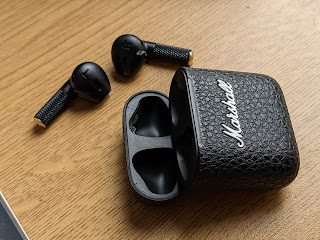
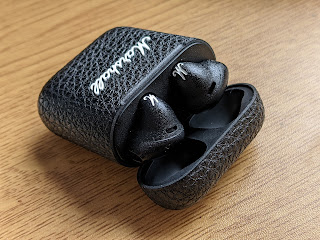
Marshall Minor III

Marshall continue to sell their stuff to people like me who wallow in the name, history and nostalgia of what the firm were (and maybe still are) about. Very often their gear is about design and style - and in my experience generally come up trumps with performance into the deal. I couldn't resist the new Minor III earbuds!

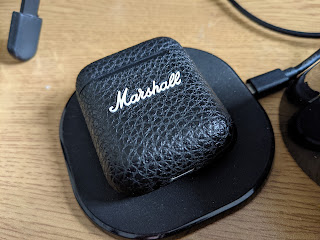
What pushed me over the edge, apart from all the above, was the fact that Marshall have adopted Qi Wireless Charging for the case, USB-C if you want to use a cable and they're not in-ear-canal buds (which I hate). They are much more like the older Apple earphones which 'sit' at the entrance to the ear. What could go wrong!

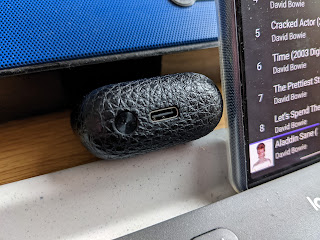
In the dinky box you get the cutest little charging case with designer 'vinyl' on the outside, a USB-C to USB-A charging cable and a little pamphlet to get you going. The case has got the iconic 'Marshall' name in white across the front, a USB-C port on the bottom alongside a pairing button and lift-back top-end in the usual way. There's a small LED on the front of the case which glows between red, yellow and green depending on charge - obviously green when fully done.

Hooking up to my Pixel 5 here invokes Google Fast Pair which means that you really don't have to do anything, rendering the Pairing button on the case redundant. In the phone's Bluetooth settings, you get an instant readout (with pictures of the Marshall gear) of charge in left, right and case. Switching to the Sony Xperia 10 Mk. III everything switches over via my Google account as if by magic. If you don't have access to this system, then yes, press that button on the case, the LED goes blue and you can pair in the manual way.

The buds are supposed to last for about 5 hours, which seems to be about right in testing here, the case holds another 20 hours of charge, so in total, heading out for the day you get 25 hours of playback before needing to charge up again. You can do this with any old USB-C cable, though the one in the box is a nice 'knurled' Marshall designed one. If you're all depleted, the case with earbuds inside takes about 2 hours to charge up again, though the buds will be done in an hour and a half. If you're in a hurry, 15 minutes will get you an hour and a half of use.

The buds are really well made but they are quite fat and big because of this. There seems to be a plastic used which is really solid and thick. They're not going to break, but if you have small ears you might struggle with the size. I have big ears, so I'm fine - though one did pop out once during my learning period of how to lodge them in my ears. All this solid design allows for IPX4 rating for sweat and (some) water resistance for using in downpours! The case also has an IPX3 rating for splashes.

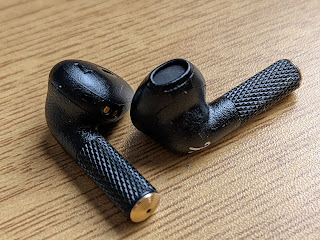
The buds themselves are very light and sit with stalks-down in the box in the usual way for charging or storing. They really are cute little things, styled like AirPods with an inch-long stalk, again with that knurled design, for style and grip when handling them. There's a big 'M' on the top-edge and gold coloured base, accented in the classic Marshall way. They really do look very smart. Incidentally, there's only one colour. You guessed it. Black! They sit very snugly in the box, certainly survive inversion and the magnet holding the lid closed is very secure.

One bud works without the other, but they're not smart enough to switch both stereo channels into the one in the ear like AirPods and Huawei units do in my experience - for this, switch your source device to force mono. If you take one out of your ear pause is executed. Put it back, and it starts again. The touch controls allow for single-tap, double-tap and triple-tap. First for play/pause (or answer/end call), second for skip-forward (or reject call) and third to skip-back tracks. This works either side the same. You can also 'slide' instead of 'tap' and actually this seems to work better for me. There's no volume controls via gestures, sadly.

Bluetooth 5.2 has been rolled out with the Minor III unit, so pretty much up to date supporting the latest SBC and AptX codecs etc. AptX fired up with the Xperia straight away by default on detection. The range seems good on tests here supporting the general 30 feet standard, only falling away outside of that, depending on interfering equipment or walls of course, as usual.

What you don't get here is any Noise Cancelling tech. Probably a good decision, given that they're not in-canal buds or sealed over-ear headphones anyway - and I'd trade that for battery life. I've tested this equation with other headphones and earphones and once you get past the 'wow' factor of how it works, I think most would go for battery. Unless of course you're specifically needing the feature for a noisy environment.

What you also don't get here is any integration with smart assistants - so no Siri, Alexa or Google Assistant. This does seem like an odd omission in 2021 when everyone but everyone seems to be doing this, particularly at this price-point. I've tested phone calls here and this works really well with the above gestures and with good call quality. Very clear voice reception and transmission reported the other end and sounding clean and sharp this end too.

Marshall audio gear, as we know, is usually very much bass-orientated for rock, which I find frankly a little over the top (and which stopped me using the Monitor headphones). I find too much bass overpowering, but get the head-bangin' thing which younger people will no doubt love, thumping and pulsating, much like me when I was 16! Maybe because these are not in-ear-canal earbuds but sit outside more, they are not so bass-driven. If you push them down further into the ear they become more so, but I'm very happy with them sat out!

This could all be adjusted of course, if Marshall had made available their App for more than the meagre half-dozen devices which it supports, making the user rely on equalisation from inside other music apps. It also rules out any firmware updates OTA going forward. I'm not sure if this is something that could be added later, but it feels like the user is out of a limb to some degree. What you get out of the retail package is what you get. Done.

Fortunately, even taking into account the above, the rest of the audio experience is very pleasing with great quality sound, too loud for my ears with test gear here, well balanced tone (for me) with a broad soundstage for stereo. More adjusted for mid-tones but listening to a range of music here, including rock, jazz, solo piano and classical, I can't complain.

I love the sound of the piano and tuning into Beethoven's Moonlight Sonata with these buds makes me feel like I'm sat right by the piano, maybe without the deeper bass of placing my head actually on the piano! Switching over from the Pixel 5 to Sony Xperia and the sound is even better, more rounded and clean, as if they were Sony's own!

These are a terrific pair of earbuds which sound great. They are focused on sound quality rather than fancy additions, explaining the lack of support for digital assistants and apps - these are for people who want to hear the sound as it was recorded to a large degree. I love the USB-C charging, the Qi Wireless charging, the Marshall iconic design, style and looks. The battery life is really not bad and using with Android devices it hooks up well with power information on the phone screen.

On the face of it, they might seem overpriced on release at £119. You can get an awful lot more features from the average set of buds out there for less money from the likes of Xiaomi, Redmi and even independent makers like Anker/Soundcore, so it's really a case of whether or not you might value the sound-orientated experience over the bells and whistles of others. Very highly recommended for those with big ears like me!

Tuesday, 4 December 2018

Ted's Top 100 Albums

Music is probably one of the most subjective and personal areas of preference with which many people associate. Preferences are often not necessarily about the music itself or the style of music itself, but what any given song or album has meant to a person during a period of their life. The tiny bit of the human brain that actually does anything readily associates sound by time and event and allocates to memory the incoming music.

For these reasons, if you asked someone what their best 100 songs were, or best 100 albums, they would take into account factors such as these if they were being honest and not trying to create an image for other people to compartmentalise them! Who on earth would have a family or children's musical in their list, for example? Yet, I have a few in there because they conjure up memories and enjoyment and association with events - and I still love to listen.

Anyway, enough waffle, here's my list! And no, I can't put them in order of preference - simply because, on any given day my preference will be different and the order would need to be shuffled! So alphabetic it is! Why not post your best 100 somewhere?
  1. Abba, Arrival
  2. Tori Amos, Little Earthquakes
  3. Barclay James Harvest, Live Tapes
  4. Carole Bayer Sager, Sometimes Late at Night
  5. Chitty Chitty Bang Bang, OST
  6. The Beatles, 1
  7. The Beatles, Abbey Road
  8. Black Sabbath, Sabbath Bloody Sabbath
  9. Blondie, Parallel Lines
  10. David Bowie, Aladdin Sane
  11. David Bowie, Diamond Dogs
  12. David Bowie, Heroes
  13. David Bowie, Hunky Dory
  14. David Bowie, Lodger
  15. David Bowie, Low
  16. David Bowie, The Man Who Sold the World
  17. David Bowie, Scary Monsters and Super Creeps
  18. David Bowie, Space Oddity
  19. David Bowie, Stage
  20. David Bowie, Station to Station
  21. David Bowie, Young Americans
  22. David Bowie, Ziggy Stardust
  23. Sarah Brightman, La Luna
  24. Budgie, If I were Brittania I'd Waive the Rules
  25. Kate Bush, The Kick Inside
  26. Kate Bush, Never Forever
  27. Vanessa Carlton, Be Not Nobody
  28. Toni Childs, House of Hope
  29. Beverley Craven, Love Scenes
  30. Cheap Trick, at Budokan
  31. Chris de Burgh, Spanish Train and Other Stories
  32. Cœur de Pirate, Cœur de Pirate
  33. Miles Davis, Kind Of Blue
  34. Dire Straits, Brothers in Arms
  35. Eagles, Hotel California
  36. ELO, Discovery
  37. ELO, Out of the Blue
  38. ELO, Time
  39. Enya, Shepherd Moons
  40. Enya, Watermark
  41. Fleetwood Mac, Rumours
  42. Peter Gabriel, 3
  43. Garbage, Garbage
  44. Garbage, Version 2.0
  45. The Human League, Dare
  46. Ian Hunter, All American Alien Boy
  47. Ian Hunter, The Artful Dodger
  48. Ian Hunter, Ian Hunter
  49. Ian Hunter, Overnight Angels
  50. Ian Hunter, Strings Attached
  51. Joe Jackson, I'm The Man
  52. Joe Jackson, Night and Day
  53. Elton John, Goodbye Yellow Brick Road
  54. Norah Jones, Come Away With Me
  55. Carole King, Tapestry
  56. Led Zeppelin, IV
  57. Little Shop of Horrors, OST
  58. Madness, One Step Beyond
  59. Bob Marley and the Wailers, Uprising
  60. Meat Loaf, Bat out of Hell
  61. Moody Blues, Days of Future Passed
  62. Alanis Morissette, Jagged Little Pill
  63. Mott the Hoople, All the Young Dudes
  64. Mott the Hoople, The Hoople
  65. Mott the Hoople, Mott
  66. The New Seekers, I'd Like to Teach the World to Sing
  67. Alan Parsons Project, Eye in the Sky
  68. Alan Parsons Project, Pyramid
  69. Alan Parsons Project, The Turn of a Friendly Card
  70. Madeleine Peyroux, Careless Love
  71. Oliver!, OST
  72. Pink Floyd, Dark Side of the Moon
  73. Pink Floyd, The Final Cut
  74. Pink Floyd, Meddle
  75. Pink Floyd, The Wall
  76. Pink Floyd, Wish You Were Here
  77. The Police, Outlandos D’Amour
  78. The Police, Regatta De Blanc
  79. Queen, A Day at the Races
  80. Queen, A Night at the Opera
  81. Queen, News of the World
  82. Queen, Queen I
  83. Queen, Queen II
  84. Queen, Queen Live Killers
  85. Queen, Sheer Heart Attack
  86. Red Hot Chili Peppers, The Getaway
  87. Lou Reed, Transformer
  88. Rush, 2112
  89. Regina Spektor, Remember Us to Life
  90. Simon and Garfunkel, Bridge Over Troubled Waters
  91. The Sound of Music, OST
  92. The Specials, The Specials
  93. Steely Dan, Can’t Buy a Thrill
  94. Steely Dan, Gaucho
  95. Steely Dan, Katie Lied
  96. Supertramp, Breakfast in America
  97. Terrorvision, How to Make Friends and Influence People
  98. Rick Wakeman, Piano Portraits
  99. Roger Waters, Amused to Death
  100. Roger Waters, Radio K.A.O.S.

Tuesday, 16 October 2018

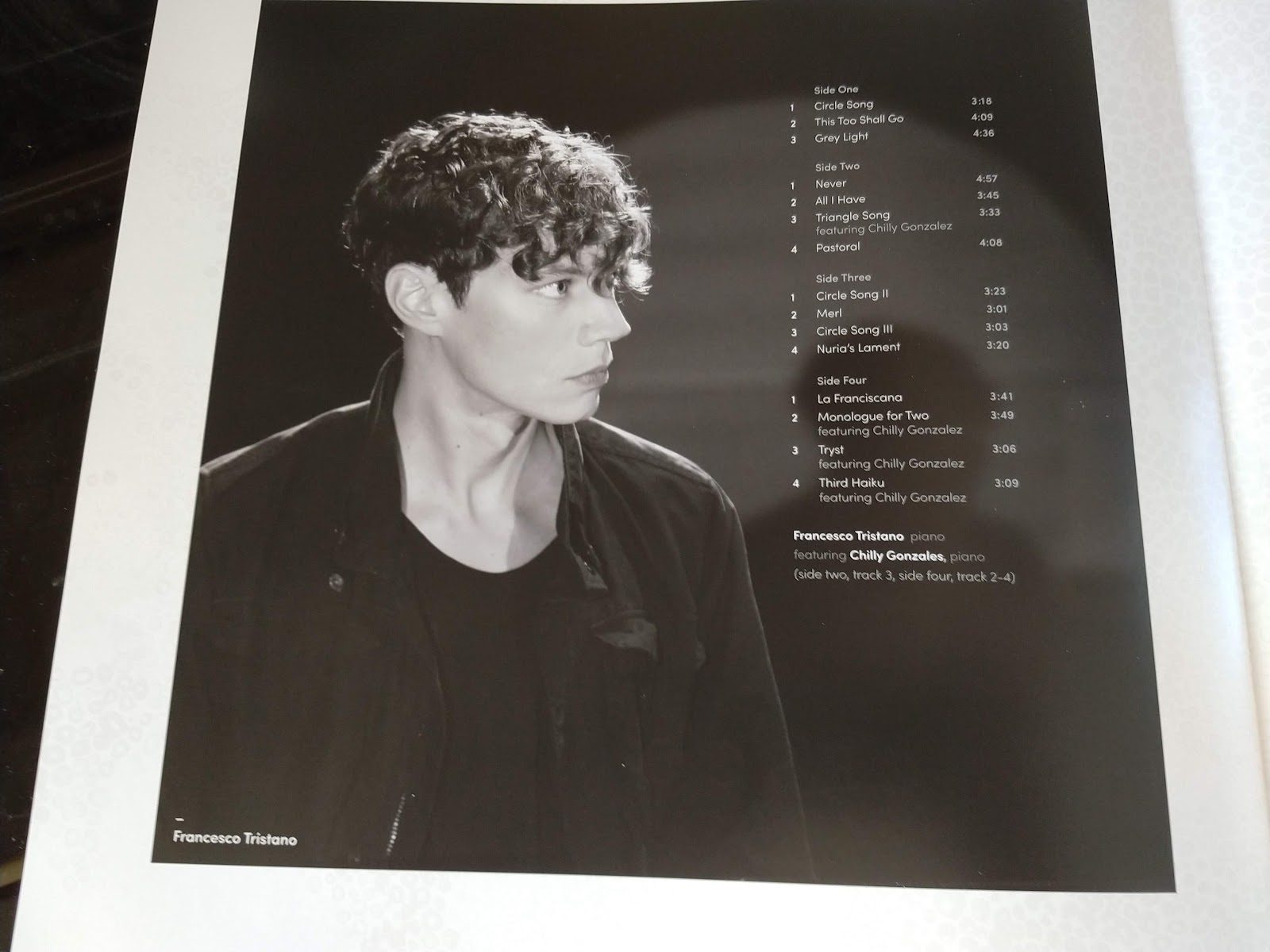
Francesco Tristano - Piano Circle Songs

Original composition for a classical musician must be a hard to break into and make a living from, aside from making a fortune! On this 2017 180g Double LP on Black Vinyl with information booklet inside and studio photos, Francesco Tristano has made a good go of it.

I'm a sucker for mellow and laid back piano-only music and he does demonstrates from this album that he can certainly compose and create interesting music. Chilly Gonzales has been roped in to help with some of the tracks and you can certainly hear which ones, with his flamboyant flair!

It's an enjoyable listen - and listen you must, or you won't appreciate the craft, often interspersed with timely waits and anticipation of what's to come and where it's going. Sometimes it feels a bit like funeral music, but never dull. Interesting and experimental, haunting and smooth, I'm pleased I found this and it is an excellent addition to the collection.

Wiki
Francesco Tristano is a Luxembourg classical and experimental pianist and composer, who also plays the clarinet and was born in 1981. He composes both classical and electronic music. Here is a selection of beautiful, newly composed works for solo piano. 'Piano Circle Songs' features award-winning Canadian pianist and songwriter Chilly Gonzales on four of the tracks, of which Gonzales composed 'Tryst' himself for the album.


Julie London - Around Midnight

As one of the jazz-based 'whisperer' singers of the 1950's and 60's, Julie London (1926-2000) enjoyed a rich career making music and films. This 180g Black Vinyl LP originally released in 1960, now comes along again and is a blend of songs from her catalogue with a theme of nighttime. It's presented here in a simple sleeve with loads of notes about her and her career on the back.

The sound is amazingly laid back and sultry, softly delivered direct from a smoke-filled jazz club cellar or two! The orchestral arrangements are uplifting and big band depict the era, and before. The backing vocals are perfectly delivered, as is the sympathetic piano and brass support. Love it. Recommended for those who like old fashioned delightful songs, tunes and singing.

Wiki
Her 35-year acting career began in film in 1944, and included roles as the female lead in numerous Westerns, co-starring with Rock Hudson in The Fat Man (1951), with Robert Taylor and John Cassavetes in Saddle the Wind (1958), and opposite Robert Mitchum in The Wonderful Country (1959). In the 1950s and 60's she released a total of 32 albums of pop and jazz with her signature song being "Cry Me a River", which she introduced in 1955. London was noted by critics for her husky, smoky voice and languid vocal style. She released her final studio album in 1969, but achieved continuing success playing the female starring role of Nurse Dixie McCall, in the television series Emergency! (1972–79), in which she appeared opposite her real-life husband, Bobby Troup. The show was produced by her ex-husband, Jack Webb.


Monday, 15 October 2018

David Bowie - Low

Like Heroes, I was very pleased to snag this 180g Remastered Vinyl LP to replace my aged and knackered original. Presented in original sleeve and inner information leaflet, it's great to have it back. There are some great tracks which I love, apart from the hit single Sound and Vision. Warsawa is my favourite, I think!

Like Heroes, it's full of experimental style and sounds, depicting that Berlin era which is oft' mentioned. It is for those who are open-minded about the nature of music and who are interested in musical development over same-old, same-old. Love it!

Wiki
The 11th studio album by David Bowie, released in January 1977. Recorded following Bowie's move to West Berlin after a period of drug addiction and personal instability, Low became the first of three collaborations with musician Brian Eno and producer Tony Visconti, later termed the "Berlin Trilogy". The album was in fact recorded largely in France, and marked a shift in Bowie's musical style toward an electronic and avant-garde approach that would be further explored on subsequent albums "Heroes" (1977) and Lodger (1979). Though it was initially met with mixed critical reviews, Low has since become widely acclaimed as one of Bowie's best and most influential works.

David Bowie - Heroes

I was very pleased eventually to replace my very old and worn out Heroes LP with this new remaster on 180g Black Vinyl with lyrics sheet inside. It's a fabulous album, just at the right time for me, in my formative years back then. The whole Berlin thing is fascinating to me and music enlightening.

There's obviously the hit single title track, but so much more for those willing to open their ears! Some of the experimentation with sound and vocals is quite superb and innovative, particularly on Side 2. Recommended for those who are open-minded.

Wiki
Heroes is the 12th studio album by David Bowie, October 1977. This second installment of his Berlin Trilogy recorded with Brian Eno and Tony Visconti, continued the ambient experiments of his previous album Low and featured the contributions of King Crimson guitarist Robert Fripp. Of the three albums, it was the only one wholly recorded in Berlin.

Chocolat

This 180g Chocolate OST Coloured Vinyl LP with inner flyer with a couple of images from the film is a very nice addition to the collection. I didn't know it was chocolate vinyl, so that was a nice surprise!

The music of Rachel Portman is largely orchestral and for fans of the film, fits in beautifully in tone, style and theme. (It's a super little film with excellent attention to detail, photography and direction.) It's uplifting, dramatic, subtle and powerful in equal measure. Recommended.

Wiki
Rachel Portman's career in music began with writing music for drama in BBC and Channel 4 films such as Oranges Are Not the Only Fruit, Mike Leigh's Four Days in July and Jim Henson's Storyteller series. Since then, Portman has written over 100 scores for film, television and theatre, including The Manchurian Candidate, Oliver Twist, Hart's War, The Legend of Bagger Vance, Beloved, Benny and Joon, Life Is Sweet, Never Let Me Go, Grey Gardens, The Duchess, One Day, The Vow, Snow Flower and the Secret Fan, The Lake House, Infamous, Mona Lisa Smile, and The Human Stain. Portman is perhaps best known for her music soundtrack compositions in the movies Chocolat and The Cider House Rules.


Thursday, 12 July 2018

Electric Light Orchestra - Time

It's Clearly Time for the Electric Light Orchestra! This a 180g Clear Vinyl re-release version of the LP.

Wiki
Time is a concept album by ELO from 1981 written about a man from the 1980s who is taken to the year 2095, where he is confronted by the dichotomy between technological advancement and a longing for past romance.

The album signalled a departure from the band's sound by emphasising electronics over its usual orchestra.

Wednesday, 11 July 2018

David Bowie - Changes One

Here presented in Clear 180g LP 'guise.

It's an album that I can't remember not having!

It's a kind of compilation really, but seems to stand up in its own right.

Originally released in 1976 and featuring songs from the previous few albums including Space Oddity, Ziggy, Aladin, Dogs, Young Americans and Station.

One to revisit frequently :-)

Meat Loaf - Bat out of Hell

Seemed like a reasonable Wednesday afternoon indulgence!
My blood red 180g LP going for a spin on a hot day.

Such a wonderfully constructed album. Jim Steinman - much overlooked - pulling the strings.
Interesting to also give his album Bad for Good an outing, which allegedly was scheduled for Meat Loaf to sing but he had to bail out because of illness.

Anyway, this one remains a peach and one of my generations' super-albums.

Tuesday, 10 July 2018

Dire Straits - Love Over Gold

Dire Straits' music doesn't seem to date, somehow, like other stuff can. This is as enjoyable now as it was first time round! This is a 180g LP bought relatively recently on the cheap from AmazonUK. Private Investigations is addictive and along with Telegraph Road engulfing Side 1, there's almost no need to turn it over ;-)

Wiki
Love over Gold is the fourth studio album by the British rock band Dire Straits released on 20th September 1982. The album produced two singles, "Private Investigations", which reached number 2 on the UK Singles Chart, and "Industrial Disease", which reached number 9 on Billboard's Hot Mainstream Rock Tracks chart in the United States. The fourteen-minute opus, "Telegraph Road" has gone on to become a favourite on FM radio worldwide. The album reached number 1 on album charts in Australia, Austria, Italy, New Zealand, Norway and the United Kingdom, and number 19 in the United States. Love over Gold was later certified gold in the United States, platinum in France and Germany and double-platinum in Canada and the United Kingdom.

God Help The Girl

As modern Musicals go, this is a peach indeed. Very well written and executed songs, help together by the scrumptious Emily Browning! It's earthy in places, reflecting the story of ordinary people trying to make a mark in music. This double 180g LP is a real soundtrack with much of the dialogue surviving where infused with songs.

Wiki
God Help the Girl is a musical project by Stuart Murdoch, leader of the Scottish indie group Belle and Sebastian, featuring a group of female vocalists, including Catherine Ireton, with Belle and Sebastian as the accompanying band. The project has released a self-titled album, an EP and several singles. Central to the project is a musical film, featuring songs from the project's recorded releases. The film was released in 2014. The songs of the project God Help the Girl belong to the genre of indie pop and resemble the other output of Belle and Sebastian in tone – two songs (Funny Little Frog and Act of the Apostle) were taken directly from the earlier repertory of this group. However, contrary to the earlier work of Belle and Sebastian (a group dominated by male performers), female vocalists (who are not members of the group) play the main role in the project. The songs themselves also tell about the problems of young girls entering adult life.

Triangle (2009)

This film is possibly the most difficult one I have ever attempted to review, because its plot twists are so tightly tied to its core themes...