Sunday, 19 February 2023

Into the Forest (2015)

This is a film more about the strength, power and bonds within a family - as they face uninformed isolation - than the apocalyptic event taking place in the world around them. Around them, but far enough away for them not to be able to discover even what it is, or what's gone wrong.

The power goes off. The car won't start. They live a two-hour walk from even the nearest small town in the woodlands of Canada. They have a generator, but dwindling fuel supplies to keep it going. The internet and radio broadcasts bringing news of what's going on cease, early on in the film - and even then, they didn't seem to know much except for the collapse of society, services and facilities. The days turn into weeks - surely, any day now it will get sorted, they'll find out what it's all about and get back to normal. Weeks turn into months and on it goes.

Our family unit consists of three. Mum seems to have died prior to the film's timeline, so there's dad, Robert, played by Callum Keith Rennie (The Man in the High Castle, Memento), older daughter Eva by Evan Rachel Wood (Whatever Works) and the star of the show Nell, depicted by Elliot (then Ellen) Page (Juno, To Rome with Love). She (now he) really is a terrific actor, cute and pretty, here, and holds the film together beautifully...

...a film which was directed and written by Patricia Rozema (Mouthpiece, Mansfield Park) and based on the novel of the same name by Jean Hegland. A novel about this small family who start from a point of relative wealth and privilege, not wanting for much, lovely house in the woods - an idyllic life, towards something different. As resources start to run out (and quite early on there's a tragedy involving dad) the two girls are left alone to work out how to survive. Fortunately, there's plenty of water as it rains an awful lot in their neck of the woods! But they have to work out how to find food and ensure that they can eat, with some interesting creative solutions and self-reliance on display.

Unfortunately, there are visits from two young men during this timeline. One, and old flame of Nell's with (apparent) word from Boston, where things are allegedly 'back to normal'. It was enough of a temptation for Nell to think about trekking on foot for an estimated eight months, with Eli, played by Max Minghella (The Handmaid's Tale), to get there. The other, a much more sinister and tragic visit with outcomes which strive to keep the girls together and strengthen their bond.

The film is sometimes slow, but purposefully, to engage the audience within the experience - a taster of what it might be like for any of us and a reminder perhaps about looking at how resourceful we would all be, given this scenario (unlikely as we might think it could be). The actors bring out a fine depiction of the frustrations, concern, anxiety and hopelessness for us to admire as well as the hope which may, any minute, be around the corner.

There's some lovely cinematography going on in this wooden wonderland and the set lends itself very nicely to injecting a sense of isolation and eventually paranoia into the viewer. The film seems to have got more than it's fair share of bad press, but I really enjoyed it and would recommend it for a viewing as it's currently included in Amazon Prime Video for those who subscribe.

Sunday, 12 February 2023

The Roads Not Taken (2020)

This film is a portrait of a broken man. A broken man not especially because of the fact that he is, in present day, suffering from some kind of dementia (which was never really labelled throughout), but also because of tragic events in his life before present day. The film flashes back to fill these gaps, using his memory within the context of what is happening now.

Leo (Javier Bardem, No Country for Old Men) is living alone, with a carer coming in and out to help him, but also under the watchful eye of Molly (Elle Fanning, A Rainy Day in New York), his daughter from his previous marriage to Rita (Laura Linney, Ozark). This is all set in a flat in New York where Leo insists on living, nearly under a railway bridge, providing more context from his tragic 'first love' relationship with Dolores (Salma Hayek, Frida).

Leo was a writer and Molly is trying hard to follow in his footsteps, but the pressure of looking after Leo grows throughout the length of the film, which is a day-in-the-life style from British writer/director/composer Sally Potter. Not quite in real-time, but certainly depicting a day. A day when Molly has Leo booked in for a dental appointment followed by an optician's one - hoping to get all that done by lunchtime in order to meet a deadline for her work.

As the film progresses, we travel with Leo's mind to spend time understanding what the relationship with Dolores was about, the passion, emotion and conflict between them - as their tragedy unfolds. We travel with him also to a time when Molly was very young and he appeared to have abandoned Rita and her to head off to Greece for 'peace to write his book'. In amongst all this, we follow Molly and Leo as they go about the day in question, meandering between disasters in the programme and crisis of confidence.

As all of this unfolds, we do get a rounded picture of what's what, the pieces of the jigsaw are put together in the end, but the central portrait remains with Leo and Bardem's harrowing depiction of this broken man. Which he does excellently. He's more 'removed' from any kind of control in his life than, for example, Anthony Hopkins in The Father, remaining passive mostly and muttering words in his native Mexican tongue and English in rotation. Alongside Fanning, they pull together impactful and moving performances which I couldn't fault. Hayek had less to do, but she also executed her usual ability to demonstrate passion and emotion in a role, whilst Linney nailed the one scene she was in - but both certainly underused. This was all about the two main characters, family bonds, daughter/father, blood is thicker than water.

There was also a message going on here about the value of human beings, regardless of their intellectual capacity as Molly berates various members of staff from the hospital, optician and dentist for their 'inhumane' approach to her father. There's also a taxi driver in one scene who does the same to a colleague, who is treating Leo with less respect than a person should receive. Another central theme is about regret, visited a couple of times in the dialogue but also demonstrated by other visual means throughout.

Sally Potter (The Party, Orlando) pulls it all together really well with just the right amount of storyline exposure at the right times, emotional engagement with the audience and I think, hits the nail on the head. I was surprised to see that the film has received less than enthusiastic appraisal from various quarters as I have watched/read various reviews - often focusing on that very point - about emotional engagement. So yes, I would counter all that and suggest that the disjointed claims are not valid and I'd assert that it was put together very nicely to achieve what it set out to do.

It's well worth a look and is now available via the usual streaming services for viewing. It's a pretty short film at under 90 minutes, but there's an awful lot packed into them and for me, the time flew as the depiction of the events and performances got right under my skin! Recommended.

Saturday, 11 February 2023

Why Do People Criticise Others?

We're all victims of criticism, but that does not make it less painful. When we are criticised we may feel embarrassed, angry or even unworthy and incapable. In fact, Winston Churchill compared criticism to physical pain and was not wrong by much, since a recent study has shown that the experiences of rejection, criticism and humiliation are processed in the same brain area that processes pain.

Obviously, not all critics generate these negative experiences - there is constructive criticism that makes you think and helps you grow. To detect that, it's important to understand what motivates people to criticise, if their reasons are valid or, conversely, are only a strategy to reassert their power, complain or humiliate.

Here's a list of 15 potential reasons why people criticise...
1. They feel threatened by some of your qualities and use criticism as a weapon to try to balance the game.
2. They are convinced that they have a right to special treatment and conditions and think that they are not getting them.
3. They like to feel responsible for the situation in every moment and get scared when they feel that are losing control.
4. They want to gain something.
5. They think they are helping you, because they are offering a part of their wisdom or experience.
6. They think that only their views are valid, then criticise you when you dare to suggest something different, which is often considered a personal attack, because, deep down, these people are often very insecure.
7. They try to attract your attention, but since they’re short of social and/or emotional skills, fail to do it in an assertive way, so they end up criticising, complaining or whining.
8. They seek admiration and approval.
9. They feel frustrated because they have tried to express their own needs and opinions in a more assertive way, but you haven’t been paying attention and, consequently, they discharge all that anger in the criticism.
10. They feel wounded by your (perhaps unintentional) words or actions, but don’t dare to say it directly and hide this dissatisfaction within a criticism.
11. They’re projecting their fears and insecurities.
12. They try to take revenge on you for a situation never completely assimilated, so they turn the criticism into a tool of humiliation and shame.
13. They need to feel powerful.
14. They have perceived your words or attitudes as a criticism, so went directly on the counter attack.
15. They envy or admire you, but do not manage to express those emotions properly, so they end up criticising exactly those qualities.

How to react to criticism?
The way to react to criticism depends largely on the situation and the reasons that cause it. In fact, there are cases where is better not to do it, because reacting to criticism would only serve to further enhance the other person and satisfy his/her desire for leadership and control. In these cases it is best to ignore them, because trying to defend ourselves would only lead to a dead end. Therefore, if you can, pretend that nothing has happened.

When the person who criticises you is important for you, it is desirable that you pay attention and let them know that you care about them, even if you do not agree with that opinion. You can also point out to that person that you respect their ideas and efforts, but always asserting your independence and the right to make your own decisions.

When it comes to a criticism made in public and you want to defend yourself, you're better focusing in on dismantling what they have said, always keeping calm. Often a quiet, concise and intelligent response is enough to make a good impression on the others. In any case, you should always reflect on criticism and, if it contains an ounce of truth, correct your behaviour, an attitude that shows maturity.

Wednesday, 1 February 2023

Clash of the Ultras - Samsung vs Motorola

I have two 'Ultra' phones in hand and they fight for my attention on a daily basis, so I thought I'd pen my thoughts about the pros and cons of each - where one shines over the other (if at all) and end up with my thoughts on which one I'd prefer to use as my daily device. So yes, it's personal!

Thanks to Motorola PR in the UK I have the Motorola Edge 30 Ultra in-hand. It's the 256GB/12GB RAM version which was formally released in the UK and I have already published my full review of it, in isolation (or at most, comparing here and there to the Motorola Edge 30 Neo - which I own and have also reviewed here). Beginning to sound like I'm a Moto Fan isn't it - and the Samsung won't stand a chance! But we shall see - and yes, I shall be straight and honest.

The contender is the Samsung Galaxy S21 Ultra, similarly, the 256GB/12GB RAM model, which I also own. Admittedly it's not the newest version of Samsung's Ultra, with the S22 Ultra having been released last year and forthcoming S23 Ultra now hours away, but I don't think that matters much really. The updating process these days with Samsung is largely evolutionary, not revolutionary, and I can't afford one anyway!

The Motorola Edge 30 Ultra was released in autumn 2022 whereas the Samsung Galaxy S21 Ultra, spring 2021, so a year and a bit between them. As I say, I don't see this as a significant obstacle to a comparison. A lot of it will be about size, no doubt, and these Ultra phones don't change much in that respect!

I'll start with size
and it's clear that the Samsung is bigger in every direction and heavier in every way. In comparison with the Motorola it feels like a hefty lump! The camera island on the back is not in the least bit subtle like the Moto's (though to be fair, the S22/23 Ultras have fixed that) and contributes largely to the fact that the device simply feels top-heavy and unbalanced in the hand. The Moto certainly wins for me here as the camera array on the back is smaller and does not impact the balance in the hand at all.

Both phones have an aluminium frame but actually, because of the styling of the two, the Moto looks much classier and premium with edges coming to a slimmer 'point' resulting in a stealth-like impression. Regardless of the Samsung's broader edges, the buttons are the same thin ones as the Moto's, though again, looking closely, they seem like plastic rather than the Moto's more 'industrial' metal design. The Samsung's buttons actually look like plastic (at least on this black model) as the back 'boulders' around the curve to the front.

Similarly, the top and bottom of the Samsung looks 'rounded' and like its plastic whereas the Moto's looks like metal, premium - and is indeed 'flat' enough to stand on-end. I don't quite understand why Samsung have gone out of their way to give users the impression that their flagship phone of the day is not terribly classy in this respect, but more pebble-like. The back of the phones differ, too, with the Moto sporting the 'matt' finish (very slippery) surface over the Samsung's straight glossy glass (and slightly more grippy).

I do understand that Samsung have tried to move away from such a 'curved' (edge) on their screens, but in the process, I think they've devalued the look and feel. Moto have also done similarly, moving away from the outrageous 'waterfall' edges of the Motorola Edge+ from 2020, which I have reviewed here and still own, but not so much. Again, Moto have retained a balance - not gone almost completely flat like the Samsung but retained enough of a curve around the screen edges to make it look premium and classy. 
So far, then, for me, the Moto is winning hands-down on look/feel and handling potential (especially with one-handed use). However, all is not as it seems and a part of that bulk of the Samsung will come out later as we look at the capability of (particularly) the two device's camera set ups.

In the meantime, a look at the retail box, battery and charging. The Samsung box has pretty much nothing in it. A SIM Card Tool and a cable. Great. Whereas the Moto is supplied with a TPU case and 125W charging brick extra! I do understand the arguments about being all eco-friendly, but I also see that having an amazing fast-charging solution (and a case) in the box is a big selling feature between the two. Samsung, Apple, Google (and a few others) have gone to town with this, painting it up as being responsible for the planet, but actually, charging the same amount to the consumer for the phone anyway!

Anyway, to charging. The Samsung is capable of a mere 25W wired charging, 15W wireless charging and 4.5W reverse wireless. The Motorola, 125W wired, 50W wireless and 10W reverse. You can clearly see the difference there, though to be fair, the S22 Ultra did up that to 45W for wired (though the rest the same and word is via leaks that this is not changing for the S23 Ultra). So, much faster charging all-round for the Moto (aside from the fact that you also get the charger). In my tests here, I have charged the Moto from flat to 100% in 21 minutes. The Samsung will do the same in well over an hour. And furthermore, it's pretty addictive watching it happen (even if not so good for the life-expectancy of the battery). Something that's there if needed - not to be used routinely.

The battery in the Samsung is 5000mAh and the Moto, 4610mAh, but this is not reflected at all in the performance of each in my testing here (and many other Samsung phones, present and past). There's a lot going on behind the scenes with a Samsung, which we'll come to later, but in my experience this always ends up with not-so-good battery life. Having said that, it's a big battery, so it's nothing like a Samsung Galaxy S10 or Samsung Galaxy Z Flip3, which were appalling in my tests (and reported widely in other reviews). But even so, if you're out and about shooting 8K video, editing it, consuming loads of media on the big screen, then expect a significantly less long experience than you would with the Moto. I estimate that the battery's performance on the Moto is something like 33% better without all that stuff going on in the background. As always with battery assessment, your mileage may vary, nay, will vary, depending on how you use your device.

We believe that the pOLED panel on the Moto is made by LG and the Samsung's is clearly their own. They are both bright and vibrant, colourful wonderful screens which nobody will be able to complain about. On the Spec. Sheet the Samsung can get brighter (in Auto), but I don't really see that here. Under certain conditions maybe, but not day-to-day. The Samsung edges ahead with 1440p over the Moto's 1080p (and resulting ppi) but the Moto counters it with 144Hz refresh rate over the Samsung's 120. For anyone who can actually tell the difference! The Samsung screen (in keeping with the size of the device) is bigger at 6.8" over the Moto's 6.67" - not much in it, but you can tell the difference in terms of what you're looking at on the screen - so for those who are OK with bigger devices and want a bit more content visible on their screens, this is a point for Samsung. Another win for the Samsung is Gorilla Glass Victus 1 over the Moto's GG5, so slightly better protection against direct impact (smashing) but much the same for (micro) scratching.

The Always-On-Display arrangements I think I'd head for a draw, regarding. Motorola's 'Peek' arrangement really is very good. It's not a 'proper' AoD but it wakes up with movement of any kind and shows the incoming notifications as a badge. If you touch/hold each of them, at the top of the screen you get a deep-dive summary of what the notification is about. Let go and it goes away. Drag your finger to the fingerprint scanner area and the phone opens up the notification source and takes you directly to the app/service to read it. I've loved this system for years and am surprised that nobody has emulated it. Furthermore, you can choose to have AlbumArt from playing music right across the top half of the screen, then swipe left/right to go back to your usual clock/time/date etc.

The reason that it's a draw is down to one (I think) unique AoD feature with the Samsung - independently-controlled brightness of whatever AoD array you decide to use (from the plethora of options via Samsung's Galaxy Store/Theming/Icons etc. open to developers). So many devices these days get the AoD brightness linked to the phone's main screen control's - and they get the algorithms wrong mostly. So many times I'm sat looking at a phone (such as a Pixel) and I simply can't see the time (unless I put it under a light to push the sensor into action). I guess this is another reason why the battery gets hit on the Samsung. The Moto does not suffer from this - in the same lighting conditions as a Pixel, for example, when touched, it comes up nice and bright. Swings and roundabouts, thus a draw.

Another win here for Samsung is the IP-rating, IP6/8, over the Moto's IP5/2. That means that it has total protection against dust (over just 'limited') and submersion in water (over, essentially, splash-resistance). In practice, how much difference this might make will depend on a person's lifestyle (and how prone they are to accidents). I can't say that I've ever dropped a phone in the bath, toilet, river or swimming pool - but I guess there's always a first time and the Samsung does bring a greater level of confidence in survival. 

This is the first device from Motorola (I believe, in the UK) where they have actually committed to the number of OS updates the phone will receive and Google Security patches too. It's taken a long time to get there, and it only applies to the higher-end flagships, but it's great to see. Three OS Updates then (up to and including Android 15) with Security updates to autumn 2026. That fills the purchaser with much more confidence going forward. Samsung's S21 Ultra was the first generation to also benefit from a firm commitment with 4 years of OS updates and 5 security, so Samsung has the edge here (although because it was released earlier, it will also get Android 15 and the same Google Security patches to spring 2026. So, buying now, regardless of release dates, they're the same - so for my purposes here with these specific devices in 2023, another draw. I guess Samsung might just edge ahead on timeliness of the updates as they are much quicker than Motorola - trying to keep up with Google and Pixels.

Comparing chipsets
, we can see that because the Moto is newer, it has a more up-to-date one, with the SnapDragon 8+ Gen 1 (4nm) over the Samsung's SnapDragon 888 or Exynos 2100 (5nm). The 15 months between the devices clearly explains that difference but nevertheless, each is blazingly fast in anything I throw at them, including gaming. The 12GB RAM on each ensures that plenty of stuff stays open in the background and each can happily support the demands of their Ready For and DeX desktop/PC implementations. Another draw then! There's no microSD card slot on either phone but users can choose (and pay the extended price for) storage up to 512GB. I do find that 256GB is the sweet-spot these days, so am happy with this amount (and can save a bit of cash), and the OS/System is indeed cleaner working just from internal memory (or via storage plugged into the USB-C slot). More level-pegging!

I'm going to be doing a specific review/appraisal of Motorola's Ready For in the coming weeks, so watch out for that one. I have assessed Samsung's DeX in various reviews (see above) over the years, so no need for another deep-dive into that. But briefly here I would say that DeX feels like it's been a bit neglected of late and Motorola have leapfrogged over Samsung into, arguably, the lead. The implementation of Ready For on the desktop is very well thought out and a recent update has enabled even more screen sizing/resolution control. The biggest difference for me, however, whether wired (HDMI) or wireless (both supported by both devices) is sending content to a TV. With the Samsung, you're pretty much getting the same 'desktop' UI that you get on a PC but Moto have reimagined a big-buttoned front-end interface which, very often, from across the room makes for much easier navigation and launching of the applications and services which people want to use. It's all about that UX and I'm giving the points to Moto here because of this feature. Anyway, watch out for my full review, coming.

Many potential users will be pleased to see the 10x Periscope Optical Zoom on the Samsung and it clearly stands above the 2x version found on the Moto. And with some justification. Having a zoom camera in a phone is an impressive feat, made available by folding optics through mirrors, like a traditional periscope, along with OIS. It gives the user everything between 24 and 240mm to play with, though this does use a secondary 10MP f4.9 sensor for the long zooming rather than the main 108MP unit. I've had great fun playing with this of course - and the Samsung's 3x zoom (with no folding trickery involved) via another 10MP f2.4 camera. The results are impressive from both, supported by smart software to assist with focus and stabilisation at that kind of range. The main 108MP f1.8 sensor by default, pixel-bins down to produce 12MP results, though for full use of the sensor there is a manual setting. This can work well in good light to squeeze out as much as possible from it - in exchange for large file sizes (13MB from about 3MB, binned). There's also a 12MP f2.2 wide-angle camera to make up the set on the back. 
There's lots of fun to be had with the array of cameras on offer from Samsung, controlled by their very capable Camera App, full of bells and whistles - and on the face of it, a clear winner for those looking for photography smarts from their phone. A full in-depth review of what these options can produce is available from the excellent GSMArena website as they drill down, test, prod and examine much more extensively.

The Motorola takes the Samsung's 108MP f1.8 sensor and ups it with a 200MP f1.9 one! At the point of release, it was certainly amongst the biggest MP count on a phone camera - and sensor, being 1/1.22". All is not quite as it seems though and it, too, pixel-bins down to 12MP results unless manually overridden. The payoff, again, is large file sizes if employed, with 4MB files becoming 26MB! I've given an appraisal of my thoughts on the camera in the Moto in my review and linked out to GSMArena again there for full in-depth, so I won't do that all again (click through to read), so rather, I'll come to my summary. 

There's no doubt at all that the 10x optical, stabilised zoom is a very attractive feature for a phone to have in its camera. As much as Moto boast the bigger sensor with a huge amount more megapixels with associated light-gathering functionality, many people will be bowled over by the flexibility of that long optical zoom. I do think that the shots taken with the Moto are exceptionally good generally, nicely balanced colours, more than sharp enough and so forth - but the reality is that neither of these are 'professional' tools and most photos taken with both of these cameras will end up being viewed on screens, not printed as posters, and probably live their life within social media. In which case, yes, the novelty of the long zoom will certainly provide 'wow' factor amongst one's mates. Both systems have their benefits and have pushed boundaries in their own ways, but there's more to consider than MPs and optical zooms. Having said that, I do think most people will be more impressed with the 10x zoom over the larger sensor, so I'll have to go with that and give the point to Samsung. Do click through though and read all about it if you can, for both phones, as there's much more behind the headline features to consider and digest.

Audio coming from tiny phone speakers is (probably) never going to be as great as any 'proper' speaker, but these two monsters have a good go at it! They both have stereo in pretty much the same format (bottom-firing right, earpiece left) and there's not much between them. If I had to choose, I'd go for the Moto, because I think that the default settings offer a slightly better sound in terms of 'tone' but the Samsung is probably louder overall. However, that bit louder, the Samsung attains with a price to pay - at full volume it tends to feel just a tad distorted, like the components are being pushed too far. Reduce it back down to, say, 80% volume and it sounds much better. But then it's lost the volume advantage over the Moto! The Moto on 100% sounds well adjusted - and that the hardware is not being pushed by the software. As always, sound output can be adjusted via the supplied tools (and other apps) and when two devices are so closely matched, a lot of it comes down to what genre of music is being played, how the audio track has been encoded and so on. I have tried to test here with a level playing field, same for both, and that is my resulting opinion. The Bluetooth output from both is loud and good quality (depending on attached equipment) and the '32-bit tuned by AKG' of the Samsung (with both sporting Dolby Atmos) doesn't really draw them apart either. It's a personal thing, they both perform well, but my ear tends towards the Moto.

Software
is the element of the assessment here which might well end up being the chalk and cheese, the love/hate and the admiration or dislike depending on the user's view and experience. I come from a background of working with Pixel phones, AndroidOne, clean interface, not too much addition in terms of bells and whistles, so I guess you might know which way I'm going here. But hold on! Because actually, over time, I have come to also appreciate the ways in which the Samsung experience can enhance the functionality, flexibility and capability of the Android OS. There was a time when I wouldn't have looked at Samsung software for long without getting straight back to a Pixel (or a cleaner Vanilla UX), but these days, I can see both sides of the argument.

The Motorola experience is, of course, the 'clean' one and closest to 'stock' Android (if such a thing exists any longer). There's no doubling up of core Google apps like the Samsung brings, with Moto making full use of what Google offer, from Contacts, EMail, Web browser, Phone and Calendar to Clock, File Manager, Photo Gallery, Knox Security, App Store, Keyboard, SMS/Messages and more. All of these with Samsung, are doubled-up as they offer their own Apps - many of which end up residing next to the Google ones (for moany of us), cluttering up the system (unless they are forcibly removed) and some installed by default. The 'Samsung world' is something of a Walled Garden where the range of apps and services they provide encourage the user to become a 'believer of the Samsung Way' and adopt it, lock stock and barrel, or make them tip-toe around the bits which they don't really want (to see). Bixby comes to mind, which Samsung persevere with, yet most people don't want to use because (probably outside of Routines) Google's tools are better. So many users try hard to get rid of it, which can be tricky with support needed for many.

On the other hand, the rich tapestry of available options, which I won't deep-dive into here, many will want to embrace - as they enable the user to control many, many aspects of the system which most other OEMs devices do not. A good example being the Good Lock app, with all the deep-rooted adjustments which can be made to all sorts of aspects of the UX - or Samsung Flow for cross-device working, Music and Video apps which are, actually, very good in many ways, Bixby Routines, theming, icons, AoD, the S-Pen functionality and so on, much of it just not available for a Moto user. There is a deep cavern to explore within the Samsung World for those who want to embrace it - and all this makes for a compelling argument in Sammy's favour! I'm back in the 'draw' camp here as I can appreciate all the above, the bells'n'whistles of the Samsung Way but also the clean, more battery-efficient and simpler world of Moto. 

Price is also a factor
here, given that, over a year down the line I paid £380 in the UK for a Samsung device which, on release, with 256GB storage and 12GB RAM would have been £1200 whereas the Moto was £749 on release (and is now frequently on sale for £649). The newer S22 Ultra with 256GB retailed at around the same price and it looks like the S23 Ultra being announced today is going to be even further away. So, in terms of value, you do pay an awful lot more for those Samsung features - at least, new.

In summary, it feels like that's what all this boils down to really - how important that vast array of hook-ins, theming, flexibility and (probably more importantly to many) that 10x optical zoom is to the buyer. Is it worth that much more money? Is it worth having to toe-the-line with the Samsung Way (or navigate and negotiate your way around much of it)? Is it worth living with a huge 'lump' of a phone, weighing down one's pockets, which really doesn't work one-handed very well? Or does the buyer save a shedload of cash (in terms of release-price) and head for a device with a cleaner, stock feel, sleeker in the hand, not bulky and weighty, a much better battery (in my tests here) and that 200MP camera?

It's a hard call and, as I say, I'm tempted (based on the used price for the Samsung) to call it a draw overall. On new prices, I certainly give it to Moto. But then I'm one who appreciates the less encumbered OS and UX. Is the phone in your pocket also your computer? Your Tablet? Your only smart device? Then maybe the Samsung is the way to go, cramming as much as one can into a (relatively) small package. For me, the balance swings the other way and I'd plump every time for the Motorola if going Ultra!

PodHubUK Podcasts for the Month of January 2023

...a roundup of our month of podcasting. Links to the team, communities and podcast homes on the net at the foot, so scroll down!

Phones Show Chat
Saturday 7th January
Ryan Stephen joins Steve Litchfield and I this weekend as we talk big iPhones, big Moto phones and big Samsung phones! Plenty of photography chat too, CES2023 highlights, updates and leaks!

Tech Addicts Podcast
Sunday 8th January
Gareth and Ted are back with a roundup of some of the CES headlines from this year's show. Lenovo, Samsung, Roku, TCL, Xiaomi, Realme, Acer and Asus all turn heads with new technological innovations - alongside a step forward in clean energy and a backwards one in diplomatic relations!

Chewing Gum for the Ears
Episode 28 - Digitising LPs!?
Monday 9th January
What's this? An episode of Chewing Gum? After 18 months out in the cold? What is the world coming to?! Steve and I natter for half an hour or so about my recent activity digitising analogue - why I'm doing it, what is there to gain, where to get used LPs, how Steve collects and stores his music and lots of other stuff around the topic.

Projector Room
Episode 129 - Warrior Watcher
Wednesday 11th January
The gang is back again to natter about what you, and we, have been watching in film, cinema and TV. Why not join Gareth, Allan and I as we theme-treat Jack Nicholson, pick our top releases of 2022, look at what's coming soon and plenty more.

Phones Show Chat
Episode 731 - Investigating Graphene
Saturday 14th January
Hold onto your hats as we deep-dive into alternative OS, Lineage-looking and Graphene-gawping with Mike Warner as Steve Litchfield and I try to keep up! It's a very interesting ride, so do join us. There's plenty of chat about other stuff too, of course.

Tech Addicts Podcast
Sunday 15th January
Gareth and I, here again, to natter for a couple of hours about what tech has caught our eyes this week. Lots of RetroTech seems to be spilling with Gen-Z not wanting to miss out on what we had! All the latest, too, of course, so why not join us!

Whatever Works
Episode 178 - Kiss Swiss Chris!
Friday 20th January
Aidan and I are here again to taunt you for an hour as we bring you Whatever Works in our lives and yours. A mouse or a Mous, Cake Ache or Aik, or even a Joby jobbie as we get a grip with suction! Loads of goodies as always, so do join us for a hoot. If it doesn't cheer you up, you can have your entrance fee back!

Phones Show Chat
Saturday 21st January
A sneaky two-header this week as Steve and I sweep up the week's news and reviews. I'm floating between Motorola and Samsung, whilst Steve's gone all test/data/stats-centric and we both demand a Green Reticule in our phones!

Tech Addicts Podcast
Sunday 22nd January
This week Gareth and I welcome Ricky West to join in the techy nerd-fun as we pick apart the week's news and any other drivel and clap-trap we've stumbled into! Ham Radio, Samsung's new ISOCELL, Nixie Tubes and Stadia - OpenAI, TikTok in landscape, Gaming Phones, Flips and Folds - we have it all. And Accessibility stuff besides!

Projector Room
Episode 130 - Kleo Kaleidoscope
Wednesday 25th January
Gareth, Allan and I are back with another roundup of all things film, cinema and TV. Plenty to natter about, as always, this time The Decline of The Munsters invokes Falling Skies as we consider Another Woman, or perhaps a Mad God! Gene Hackman features in Themed Treats, who was better than The Last of Us.

Phones Show Chat
Saturday 28th January
Here's this weekend's chat for you as Steve and I welcome Sethu Pillai back. We hear about his time working for Nokia and find out which devices he's favouring just now. Plus loads of other content as always.

Tech Addicts Podcast
Sunday 29th January
Gareth and I bring you this weekend's top tech tinctures as we duck and dive around what's new. Getting ready to Unpack with Samsung, Pad-up with OnePlus/Oppo, perch on the Razer's Edge, create some AI-Musical scores and go all ELP on Laser Turntables!


Thursday, 26 January 2023

Watcher (2022)

This is a 1990's style thriller pulled together by relative newbie director/writer Chloe Okuno which has been (eventually) pushed out to Mubi, Shudder (UK) and Amazon Prime Video for streaming - and is well worth a look.

An American actress arrives in Romania with her husband, who has been offered a good opportunity for work. He has come from Romania originally and they had been living in the USA prior to this switch. All seems well at first and they move into an apartment which is overlooked by apartments opposite. Think Hitchcock's Rear Window or more recently, the very similar in many ways, The Voyeurs.

She's bored to tears each day as he goes to work long hours and leaves her alone and unstimulated in a new country with no friends or anything to do. She strikes up a friendship with a girl who lives in the apartment next door, but it's quite shallow. When they are out with his friends and work colleagues, try as she might to learn the language, everyone around her is speaking in Romanian, excluding her, building on her isolation. Her husband tries to include her, but it's a tricky situation.

The greater concern for her though, is that there's a man standing in the window of an apartment across the way who seems to be constantly staring at her, whenever it is dark, no lights on, so she can't see him clearly. And of course, whenever husband is home, he's not there! And furthermore, it seems to take them three-quarters of the film to work out that perhaps they should have curtains up at their apartment-wide huge windows!

Simultaneously, there's a serial killer on the loose who is lopping young girls' heads off, spookily enough, about the same age as Julia, our increasingly paranoid starlet. Francis, the husband, tries to appease her for a large part of the film, but doesn't really believe her, which eventually leads to tension in the relationship. We're led to believe of course, that the bloke across the way is the likely predator but when The Spider (as the press had dubbed the serial killer) is caught, she, and we, are let off the hook a bit - and she's able to relax slightly. But she's still spooked by odd-ball's presence, especially when he starts following her!

Maika Monroe (It Follows, The Guest) plays Julia very well as her anxiety increases, apparent paranoia runs away with her, nobody believes her and, of course, with the fears possibly all in her head. The elements for a pretty taught thriller. Karl Glusman (Love, Greyhound) as Francis does a decent enough job in support, but is certainly second-fiddle to Monroe. We can certainly see who has the limelight in pretty much every scene, the director encouraging the viewer to stay with Julia and feel her anxiety. Burn Gorman (The Dark Knight Rises) plays the slimy, creepy looking bloke who she believes is following her (and possibly the bloke in the window watching her, she thinks) and really looks the part, to add to the tension.

The rest of the film approaches edge-of-the-seat at times, but it's also slow in parts too. It's well constructed though and the reveals are well-paced with enough clues as to what's going on during the show. A little predictable, I guess, but if you're a fan of 90's thrillers, you'll be used to that. Doesn't take away anything from the enjoyment and ride.

The film is quite nicely shot, with good use of lighting, shadows, camera-angles and shallow depth of field. A lot of it is inside the apartment block but we do also get a flavour of what Bucharest is like, their culture and climate. But yes, it's been done before many times and this doesn't particularly stand out in any particular way - it's just a good fun thriller which is an enjoyable watch. Recommended.

Monday, 16 January 2023

Motorola Edge 30 Ultra (2022)

Motorola phones, over the years, have always caught my eye and encouraged me to part with my 'well-earned'. There have been some exceptions and frustrating parts of the long-standing affair, but generally I'm onboard with what they do with Android, how they do it, what they add to the experience and the very nicely thought out hardware choices - usually at decent prices, especially since the hook-up with Lenovo.

I recently bought the Motorola Edge 30 Neo and found it very hard to fault in my review in November, especially for the (now) £299 price-point. The Edge 30 series has enthused me, specifically, so I was delighted to receive a review unit of the Edge 30 Ultra from Motorola PR in the UK here to review as well (known in China as the X30 Pro). The third in the range is the Fusion, which seems to have a bit of an odd feature-set in some ways, but sits between the Ultra and Neo. I have not seen this one yet.

One of the frustrations about Motorola over recent years has been promises of OS and Security updates. I'm still sitting here with a 2020 Edge Plus, a premium £1000+ flagship, then exactly two updates after launch, it was suddenly abandoned by the firm. That's not good - and it seems that Sony have now emulated the practice with their Xperia range. Motorola seem to have woken up and smelt the coffee this time round though and have, at least, with the Ultra in the Edge 30 range, promised 3 OS updates and 4 years of security. A step forward, but we'd like to see this now for the non-flagship units too, which Samsung have now committed to across most of their range. Please Moto!

Their argument is that they can keep prices down if they only spend time and money on keeping up to date the devices that they know that most people are using, which they can track, and not wasting effort on the devices that are no longer used in such big numbers. They also, of course, want people to buy new devices from them, and seem to think that everyone changes their phone every two years. That landscape is changing and it looks like we see the firm adjusting their approach in reaction to that change. Good.

Anyway, back to the topic and journey to discover whether or not the Ultra can nab my SIM Card from the Neo (where it has been most often since November). Note that I say SIM Card because the Motorola Edge 30 range don't yet support eSIM functionality, so anyone looking for that needs to look elsewhere for now. They, along with most others, will get there in time - as sure as they will drop 3.5mm audio-out sockets and microSD Cards!

The plastic-free box that the phone came in is an eco-friendly looking one, tree-bark coloured to emphasise the point, and inside we have a pokey-hole key for the aforementioned SIM Card tray, a soft and flexible TPU case (well done Moto) and the star of the show - yes, in the box - a 125W TurboPower charging plug and thick, supporting USB cable. Perhaps that's where we should start because it's a mightily impressive option to have for charging.

In testing here, I have been able to charge the phone's 4,610mAh battery from 0-100% in 22 minutes. I do realise that there is even faster charging out there from some Chinese OEMs for some phones, with the arrival of 240W charging, but I'm not sure that in real world situations, what the difference is between 22 minutes and 9! It's still super-fast! Furthermore, unlike some OEMs who will only enable the functionality with their own brick and cable (thinking Oppo and OnePlus VOOC) I have been getting very nearly as fast speeds with my more generic USB cable and GaN 100W charger with the Ultra here. So yes, Turbo-fast charging when needed. But there's more...

Wireless charging, trickle for most of us overnight, but for those who fancy buying a 50W Qi Charger, the Ultra will support that as well, so even super-fast charging speeds on the stand/cradle too. At time of writing, in the UK, it's hard to source Moto's own 50W stand, but others can be purchased. Apparently, the Chinese authorities decided to 'cap' wireless charging at 50W - but that's a story for another day. We don't all need Turbo-speed charging all the time - and there are arguments against, for the long-term health of batteries - but it's great to have the option when needed, out and about on busy days. There's also 10W Reverse Wireless charging available for topping up your friend's phone or earphones on-the-fly.

The battery performance, however, seems to ensure that unless a person is caning the phone shooting hours of 8K video or heavy gaming, it should last most people in normal use at least a day and with moderate/light use, two. I have been tracking this for the last couple of weeks and am getting 48 hours of battery with 6-8hrs screen on time. One day I had of very light use returned me 14 hours away from the charger with 2 hours of SoT and a whopping 80% battery power left. Clearly, stand-by time is exceptional with this phone, even with a power-hungry chipset and big, bright screen to drive.

My 10% Reading Test returns me about two and a half hours, so not quite as good as the Neo, but still very good indeed and much better than the Samsung Galaxy S21 Ultra. I am planning, incidentally, a Battle of the Ultras with these two devices sometime soon, so watch out on my blog here for that. There has been one caveat pertaining to all the above however, and that has been some strange readings from the onboard status bar percentage readout. During the first few days, it was clearly displaying data that couldn't possibly be the case, like remaining on 100% after 6 hours of use - but as it has settled down and got used to my usage pattern, it has become more reliable. I think it is a bug though, which needs to be sorted out in software updates as we go forward.

Hopefully we shall be able to keep the device long enough to see Android 13 arrive and a good number of monthly updates to iron this out. In the meantime, I would suggest that users turn on all the battery assist functions in settings - Adaptive Battery, Optimised Charging and Overcharge Protection. I have done that since discovering these issues and it does now seem a bit more reliable. So, all the figures above, should be viewed with this in mind. I shall come back and report on changes as software comes in, as long as PR leave the phone with us.

The phone was released in September last year on Android 12 and has now, as I write in January 2023, had December 2022 Google Security pushed OTA to it. I would expect Android 13 to arrive in the first quarter of 2023, but we'll see. I'll come to the software experience later but for now, I'll return to the physical, having leapfrogged it initially, drowned with enthusiasm for power and charging!

The phone feels totally premium in the hand, it's reassuringly hefty at almost 200g and sized much like an 'Ultra' phone. There is 'only' IP5/2 environmental protection although I understand that Moto still do the nano-coating internally to make things better than they seem - but officially, yes, it's 'splash resistant'. The front and back are made from Gorilla Glass 5 and there was a factory-fitted screen protector on, out of the box. These just get in the way! Take it off! It's true that GG5 is not Victus, so may be more susceptible to breakage, but micro-scratches are hard to avoid whatever the screen tech, we have found. It's very similar in size to my Motorola Edge+ (2020), except that it's a bit wider, as although they have the same screen size, the older model has wild 'waterfall' edges left and right, which make it a little narrower - but there's not much in it. It's also not far off the size of my Samsung Galaxy S21 Ultra, but the latter is a bit wider and fatter, making it feel/seem like more of a 'lump' in the hand!

The back and front curve around to meet the aluminium frame which becomes, unlike the Edge+ (2020), centralised and very thin. This makes the volume rocker and power button on the right very slim indeed, but also premium-feeling, no play, solid. There's nothing on the left side except antenna-breaks, as there are all round, and down at the bottom (which, like the Edge+ is flat and for those brave enough, can be stood on-end) is the 'right' speaker, a centralised USB-C port and a dual (back to back) 5G nanoSIM Card tray. At the top, in the middle is a subtly etched "Dolby Atmos" emblem/logo.

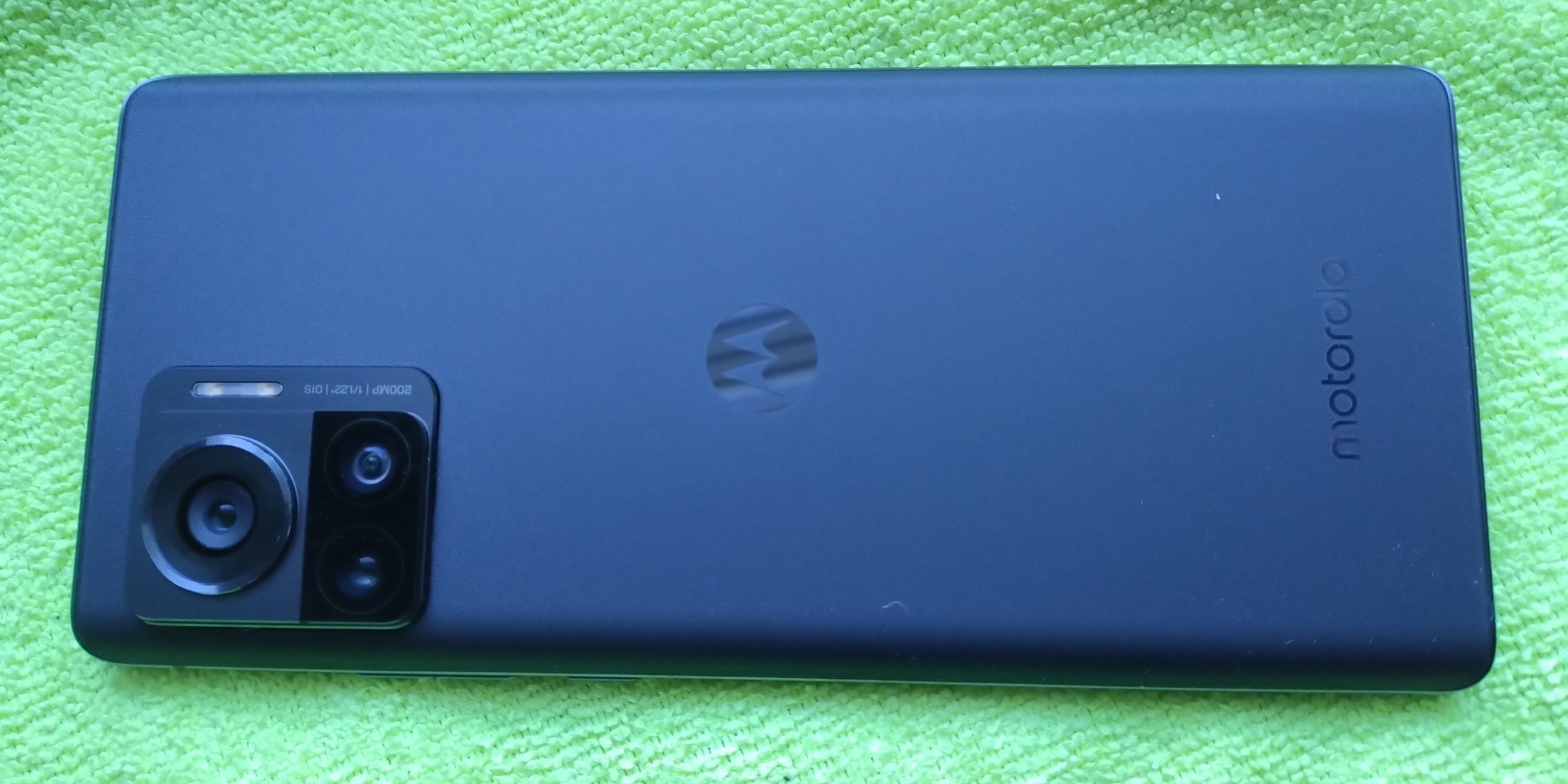
The back of the phone appears to be the most slippery surface known to humanity! I thought the Nexus 4 was slippery, but this takes the crown. If it wasn't for the camera island, it would simply slide off flat surfaces. Work that one out! It's a beautiful, velvet-like texture, matt, somehow, not even glossy. Very classy - but making it essential to use the included (very tight-fitting) TPU case. There's the usual Moto 'M' in the middle of the back, the word Motorola low-down, subtly etched into the glass and top-left (in portrait), the camera island.

The camera island is a three-tier unit, stepping up like a wedding cake! On the first layer we have the LED flash and words, reassuring the user that there's a 200MP camera in the cluster with OIS. The second tier houses the supporting two other camera lenses and the final 'top' tier, the 200MP camera itself. This is surrounded by (what appears to be) a metal ring, sitting proud of the glass - but even with the supplied TPU in place, it is not protected from touching a flat surface. This means that when the phone is placed down on a table/desk, it hits this ring. Hopefully this isn't damaging the camera in any way, but it will be interesting to see, over time, if there are scratches/dents in it.

The front of the phone is an almost flat, black, sheet of glass with those slight curves around the edges, left and right. There's a narrow 'slit' above the screen which serves as the earpiece for calls and the 'left' speaker for media. There are almost no bezels left and right (and they are 'round the curve' anyway). Similarly at the top, with a very slightly bigger one at the foot of the screen. There's a Selfie punch-hole camera top/centre which is not too intrusive - I've seen smaller and bigger - and as we know, our brains learn to not see it!

The panel is a 6.67", 1080p, p-OLED unit, like the Neo's, with a billion colours and a 144Hz Refresh Rate. I wish I could tell the difference between this and 90 (or even 60) but those around me report that it does indeed make a big impact for them, so 144Hz is certainly up there with the leading pack. The user can choose between 60Hz, 144Hz or Auto, to let the system decide (which does then include 90). I think that the screen is the same stock, only bigger, of the one on the Neo - they look the same to me. Bright and colourful with saturated, rich colours. It has a screen ratio of 20:9 and returns 395ppi. One difference between this and the Neo is that whilst the Neo 'only' peaks at 1000nits of brightness, this can reach 1250nits (though on further research, this seems to be only in certain conditions and only in the whites, reaffirming to me that the Neo has the same panel tech, pretty much). They are excellent, both, and up against a Samsung phone, with some uses, they look even better - which is praise indeed for LG who we do believe still makes their p-OLED panels for Moto.

The phone has the all-but bang-up-to-date chipset in the SnapDragon 8+ Gen 1 (4nm) and you can tell. The power and speed when executing heavy-lifting tasks like copying data to a PC, updating apps, playing games and so on - it simply flies. This does represent one differences from the Neo, for sure, with it's power/budget-friendly SD695. The 12GB RAM helps the multitasking with the likes of Ready For when hooked up to a PC/TV or NexDock device and when keeping many apps open in the background for quick-switching. My next article relating to the Motorola Edge 30 range of devices here on my blog will be focused on Ready For (cabled and wireless), by the way, so look out for that, coming soon.

There are a number of variations of the phone available in different regions, the 128GB Storage/8GB RAM version appears to available in India only, there's also a 256GB/8GB version, the only one that I can find for sale in the UK is this £749 256GB/12GB unit and somewhere out there, there's a 512GB/12GB version! There's no microSD card slot, but even the lowest 128GB version should be enough for most folk, not pushing limits. I'm quite happy with 256GB with the HDMI-Out functionality, downloading streaming services' media content for later viewing offline. As I say, I'll come to that in another post. The storage is UFS3.1 rated and read/write speeds seem fast to me, compared to some others which don't support that protocol.

The output from the stereo speakers sound very similar indeed to that from the Neo. It's a bit fuller - I'm guessing because of the bigger, metal/glass frame affording more space for the sound to move around - but there's not much in it. They really are (both) very good indeed. I've been comparing the output with the Sony Xperia 5 Mk.IV and Motorola Edge Plus (2020) and the results are surprisingly comparable. The volume is really very loud - as top-notch as the Edge+'s reproduction. Users can employ the Bass Boost (particularly) in the Dolby Atmos Pre-Sets or use the excellent Wavelet app to achieve similar. Whichever method is employed, you get to that same equation of quality/volume. I was surprised, however, that whatever I did with the output from the Xperia, I preferred the sound coming from this Moto, £250 less to buy! Yeah, I know, there's lots of other stuff you're paying for with the Sony too, but up until now I really thought that the Mk.IV was only going to be beaten by my Edge+, not coming in 4th here behind these three Motos!

The Dolby Atmos settings are the extended set, so lots of control over speakers as well as headphones - including full manual sliders - and yes, they really do make a difference with the right combination. They also continue to make available the Surround Virtualiser which, again, makes a significant difference to the stereo impact with both music soundstage/width and video/film with decent soundtracks. Placed 18" in front of the head and the listener can appreciate some clever software-driven speaker output enhancement going on, which is most impressive and enjoyable. This unit is equipped with Bluetooth 5.2, so a slight step up from the Neo's 5.1, utilising A2DP, LE, aptX HD and aptX Adaptive.

Connectivity is sound, it seems. The Bluetooth range seems to be solid, depending on quality of connected equipment of course, NFC for connecting to other gear seems to work as it should along with Google Pay - and cellular connectivity seems very good indeed. I have had various phone calls over the last fortnight and it didn't flinch, the whole time. When it comes to WiFi, Moto have equipped the Ultra with 6e, so right up with the latest (for those who can make use of it) unlike the Neo, which is still having to use the v5 protocol. I have not noticed anything wrong with my connection, good and fast with no hitches or blips. There's 5G connectivity on the phone of course but I'm afraid that where I live I'm unable to test that. I'm more than happy on 4G though - there's nothing I do or nowhere I go which makes me think that I might need 5G but I guess everyone's lifestyle is different. I might be worse off in a football stadium than those with 5G. If I went to one!

I've always quite liked what Moto do with their Camera software and this is no exception. The headline here is the 200MP f1.9 camera with OIS which my colleague Steve Litchfield at Phones Show Chat put to the test and you can see his video coverage here. Shooting at full resolution produces excellent results, although user beware that unless you specifically want/select that (with much, much bigger file sizes) the unit will default to pixel-binning down to 12MP shots. Which are still very, very good indeed, incidentally.

The supporting shooters are a 2x optical zoom through the 12MP f1.6 unit and a 50MP f2.2 wide-angle lens. There's even a 60MP f2.2 Selfie - so for anyone keen on top-notch photos, they will no doubt find the differences from the Neo here significant. In my tests I think that all the cameras shoot fine pictures, certainly in good light, and the wide-angle at 0.5x too. The jewel in the crown for me here though is the close-focus, dubbed 'Macro'. It's really very impressive, very similar to the Neo's, compared to most others which I have tried here. There's a 'Macro' badge present in most modes on the main view next to '0.5' and '1' and it seems to switch to the wide-angle lens when you get close enough. There are plenty of manual controls to override this and use it how it suits.

The Night Vision seems to work very impressively - you are led through that 'hold still' procedure, then watch as a photo appears - with subjects in the frame that even the human eye can't see! The shots are just great. The portrait mode seems to do a decent enough job with controlled depth of field - and you get that fun Spot Colour toy to play with along with a bunch of other modes too. You can edit which modes you want to see on the main view (Samsung style) and dive into settings for a bunch of other tweaks and adjustments. Unlike the Neo, there's 4K (60fps) and 8K (30fps) video shooting available and even 4K at 30fps via the Selfie.

Anyway, I shall soon be out of my depth with digital photography, so I shall do my usual trick here of handing over to the folk at GSMArena who do a great job as they test, prod, poke, sample, assess and conclude. They seem to always know what they're doing (much more than I could) which is why I refer to them so often. Do please support them by visiting their site for the latest mobile news and to tune into their excellent phone reviews.

In terms of device access security, we have an under display, optical fingerprint scanner and face unlock. The fingerprint scanner is thorough in setup and works pretty well, though I think not quite as well as the ultrasonic of some Samsung models and certainly not physical, capacitive ones. But the technology/software does seem to be getting better. The Face Unlock is even more thorough - like with the Neo, it just won't let me register my face with my full beard. If I pull a stupid grin, it sometimes starts the process, but never gets to the end. In order to make this work (I kid you not) I cut my beard off! Then, it worked fine and continues to work, recognising me first time, every time. So the combination of both of these is excellent. Obviously people who use Moto phones are not allowed beards!

Moving to the software experience, the usual set of Moto features and gestures are onboard here with chop-chop for torch, twist-twist for camera, 3-finger screenshot, Lift to Wake, tap to wake, Attentive Display (stays on when looking at it), flip for DND and more. The excellent Peek Display is here too, where the sleeping screen can be interacted with to see summaries of notifications or deal with playing music and a bunch of other stuff. It's not a true Always on Display, but it's the next best thing - and in some ways, better. It does seem that Moto have done away with the Approach feature for good now, which enabled a wave over the screen to enliven it to Peek, but I guess they figured that if the waving hand is there anyway, it might as well tap the screen. Fair point.

You get the personalisation options of layout, font, colours (like Material You), choose Icon shape, system theme and more. This is well thought out and in keeping with what Google are doing on Pixels (and now others when Android 13 arrives). All good stuff and very Samsung. Edge Lighting is another great Samsung feature which is present here, but not in the Neo (as it needs a screen that's not flat to qualify with Moto). This gives the user a choice of 5 colours to 'glow' the edges on notifications from a list of options. Another way Moto is getting more Samsung-like, I noticed, is with App Drawer 'folders'. Yes, you can now arrange your App Drawer in the same way you can as if it's on the home screen, thus becoming another home screen, I suppose! Colour background for folders should be next, with a 'hidden apps' area!

The Backup/Restore works pretty well phone-to-phone using Google's tools - either wirelessly or by cable. This is another area where the user can see how fast the phone's processor is as it whips through the copy-over task. There are a couple of apps pre-installed by Moto here, probably depending on region, but for the UK it was FaceBook and a Solitaire game (which appears to be an app-link to a 3rd party). However, both are uninstallable, so that's good. There was another apparent bug in my unit during this process when the process got stuck halfway through, a reboot fixed. I don't know if that was Google or Moto - either way, it would be good to see that ironed out in a software update.

Gamers have some special settings to enhance their enjoyment with a dedicated Games front-end (app) where installed games are automatically included. Launching from inside that wrapper then sets things going and Moto presents an icon on the left which brings forth a little gaming control panel, with controls for volume and brightness, blocking buttons for calls and notifications, a dedicated screenshot button, share, touch sensitivity and even one to launch live Twitch streaming, for those who want to do that! As an aside, and going back to sound/speakers, the sound coming out whilst gaming seems even better and louder than via music and video, as tested earlier. Good job Moto!

The software experience is otherwise very close to Google, to Pixel, to AndroidOne in many ways and not veering off into a multi-layered virtual OS of it's own, like Samsung. Some will see this as positive, while others will appreciate the bells and whistles of the latter. For me, it feels like a good balance between the two and I end up liking, very much, the Moto approach.

The Motorola Edge 30 Ultra is a great phone and worthy member of the Edge 30 family. My primary daily phone just now is the Motorola Edge 30 Neo and the big question for me is about size. The 6.28" screen on the Neo is just about perfect for one-handed use, whereas the leap up to 6.67" here, though not as big as some Ultra models, is quite a change. When I try to reach the top of the screen with one hand, it's a stretch. Moto have dropped down some of the screen elements, like Samsung with One UI, and there is a perfectly good one-handed mode (swipe down) but it's also about balance in the hand and weight distribution. So, something to consider.

The phone is more powerful, there is no doubt, with an all-singing modern chipset and more RAM, and the user gets full access to wired Ready For with the Ultra instead of just the wireless version (which, as I said above, I shall cover separately). There's more storage, that 200MP camera, a zoom camera, in fact - better cameras all round and a faster charging battery. On the other hand, the Neo is significantly cheaper, has pretty much the same lovely p-OLED panel, 68W charging with brick in the box and, it could be argued, is less vulnerable to accidents with a flat screen instead of curved and a plastic body, more ready for the rough and tumble!

Both of these phones are cracking devices. The Neo punches way above its weight, but for ultimate power, with every box ticked, pretty much, it's the Ultra. Both of them highly recommended.

Triangle (2009)

This film is possibly the most difficult one I have ever attempted to review, because its plot twists are so tightly tied to its core themes...